



Step on a fire ant mound barefoot, and you’ll never forget it. Within seconds, dozens of tiny red soldiers surge up your legs, each sting burning like a matchstick pressed against your skin. That fiery pain is how they got their name. But red imported fire ants (Solenopsis invicta) are more than just a nuisance; they’re an invasive species reshaping Texas pastures, lawns, and fields one mound at a time.
For landowners, they’re trouble on every front: they injure livestock and pets, damage equipment and infrastructure, and displace the native ants that once helped keep them in check.
Why Red Imported Fire Ants Thrive in Texas
Red imported fire ants aren’t native to Texas. They first arrived in the U.S. in the 1930s, stowed away in cargo from South America. Once here, they found Texas a perfect new home. Our warm climate, open rangelands, and long growing seasons gave them everything they needed to spread.
Unlike most of our native ants that coexist quietly, fire ants build sprawling colonies and defend them aggressively. Once they’ve claimed a patch of ground, they don’t easily give it up.
Sneaky mound builders
Here’s something most folks don’t realize: fire ant mounds don’t have an entrance hole on top. At first glance, they just look like a dome of dirt. Innocent enough until you disturb it. The ants use hidden underground tunnels that can stretch several feet away from the mound, popping up like surprise exits. That’s why you might stomp the mound and see ants spilling out of the ground a yard away.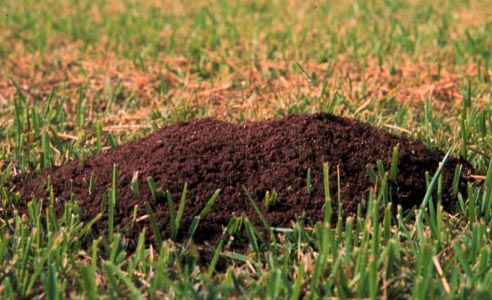
Why fire ants so tough to control
Unlike most native ants, red imported fire ants often have multiple queens in a colony. Take out one queen, and another can keep the colony going strong. That’s one of the reasons DIY treatments often disappoint. Without hitting the heart of the colony, you’re just scratching the surface.
And if you’ve ever wondered why fire ants seem to bounce back after floods, here’s a wild fact: when water rises, they link their bodies together into a living raft, floating downstream until they can settle somewhere new. It’s one of nature’s grimmest survival strategies, and another reason they spread so quickly across Texas.
Are fire ants dangerous?
The short answer is yes. Fire ants aren’t just a backyard irritation—they’re a real threat to people, pets, livestock, and property. Their painful stings are only the beginning. These invasive insects have a way of turning up where they’re least welcome, and the damage they cause can be costly.
- To people and pets – Fire ant stings burn, blister, and itch for hours and sometimes days. For some, they can trigger dangerous allergic reactions. Pets, especially curious dogs, are frequent victims when they nose into a mound and end up with faces or paws covered in painful stings.
- To wildlife and livestock – Newborn fawns, calves, and foals, along with ground-nesting game birds, are particularly at risk. Fire ants swarm quickly, stinging tender areas like eyes, ears, and muzzles. In severe cases, this can cause blindness or even death. Texas ranchers have reported calf losses directly linked to fire ant attacks during calving season.
- To property – Fire ants don’t just stay in the soil. They’re notorious for infiltrating electrical boxes, irrigation controllers, and air conditioning units, often causing short circuits and expensive repairs. Their tunneling also loosens soil, damaging root systems and weakening turf.
Fire ants cost Texans millions of dollars each year in veterinary care, livestock losses, crop damage, and infrastructure repairs.
How to get rid of red fire ants
There’s no sugarcoating it: fire ants are stubborn.
A single mound may look small, but underground it can house thousands of workers and multiple queens. Knock it back the wrong way, and the colony just rebounds—or worse, splits into two. That’s why pest professionals and Extension experts recommend these two approaches: broadcast bait plus individual mound treatments.
Broadcast Bait
Think of broadcast bait as the “big sweep.” Instead of spraying or drenching, you spread tiny granules of food laced with a slow-acting insecticide. Worker ants pick it up, carry it home, and share it with the colony. To minimize harm to native ants, broadcasting baits should only be used when red imported fire ant densities exceed several hundred mounds per acre.
- How it’s applied – Typically 1 to 1.5 pounds of bait per acre.
- What’s in it – Fast-acting toxicants like indoxacarb give quick knockdown, while hydramethylnon works moderately fast. Insect growth regulators (IGRs) like methoprene or pyriproxyfen don’t kill immediately, but they keep new ants from developing—slowing the population over time.
- The tradeoff – Broadcast bait is efficient for large infestations, but it comes with a cost: it can also impact native ants, which play an important role in keeping ecosystems healthy.
Individual Mound Treatments (IMT)
Once the broad sweep has weakened colonies, it’s time to get surgical.
- How it’s applied – Directly to the mound using dusts, granules, liquid drenches, aerosol injections, or fast-acting baits. Even hot water can be used, though success rates are lower (20–60%) and repeat applications are often needed.
- Why it works – By treating from the outside edge inward, the product reaches deep enough to kill the queen. Without her, the colony collapses.
- Effective products – Ingredients like indoxacarb, hydramethylnon, abamectin, and spinosad are proven winners, sometimes wiping out colonies in as little as a week.
When selective IMT makes more sense
The goal isn’t just “kill ants.” It protects your land, livestock, pets, and the natural balance of your property. That’s why we don’t blanket the landscape with broadcast bait that could harm beneficial species.
For sensitive areas, such as conservation plots, pollinator gardens, or locations where you want to preserve native ants, broadcasting may not be the best choice. In such situations, individual mound treatments, although more labor-intensive, provide effective control while minimizing collateral damage.
By treating mounds directly, we eliminate colonies without disrupting native ants that actually help keep fire ants in check. It’s a precise, property-friendly strategy that works with your land instead of against it.
This approach is more sustainable, more selective, and ultimately, more effective.
Taking back your land
Red imported fire ants may be small, but they’ve built an empire in Texas. They thrive in our weather, on our open land, and even in our floods. But they’re not unbeatable. With a focused strategy, mound by mound, season by season, you can protect your livestock, your pets, and your land from their painful sting.
At Landmark Wildlife, we’re here to help landowners fight back with precision, care, and proven methods. Because when it comes to your property, the only colonies worth building are the ones you choose—not the ones an invasive insect floats in on.